By HABASA Ange Felix, Master of Education (MED)
Rwanda is witnessing a significant shift in the ownership of adult literacy centers, with churches playing an increasingly important role in promoting education among adults. This change reflects a growing partnership between faith-based institutions and national efforts to improve literacy levels across the country.
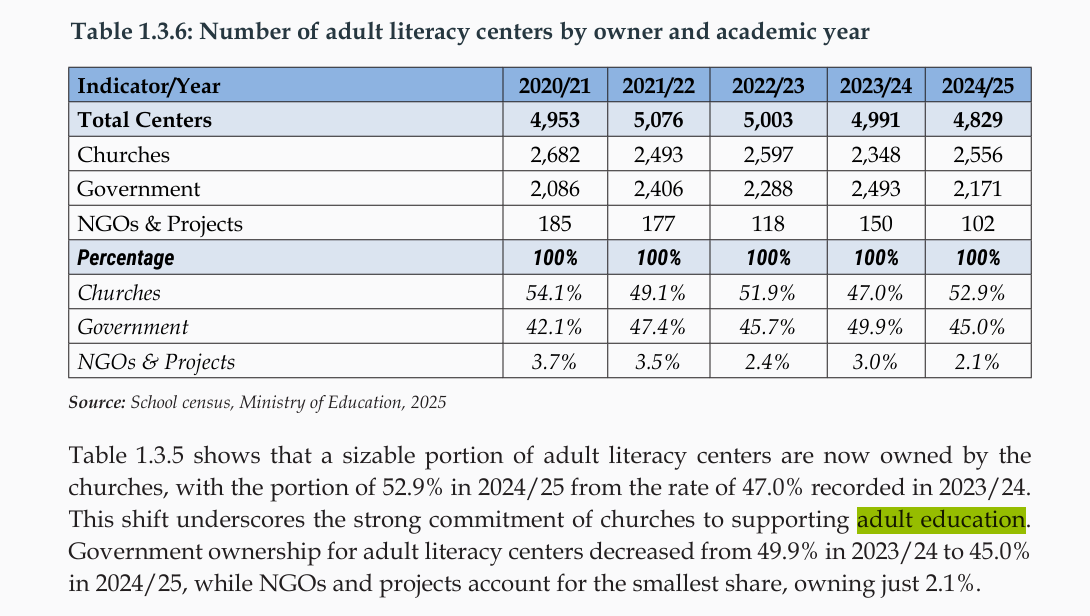
Recent education data for the academic year 2024/25 shows that churches now own 52.9% of all adult literacy centers, up from 47.0% recorded in 2023/24. This steady increase highlights the strong commitment of churches to support adult education and community development.
Faith-based organizations have long been involved in education in Rwanda. Major religious institutions such as the Catholic Church and Protestant denominations have historically contributed to the establishment of schools and learning centers. Their continued involvement in adult literacy programmes demonstrates their dedication to improving lives beyond formal schooling.
At the same time, government ownership of adult literacy centers has decreased from 49.9% in 2023/24 to 45.0% in 2024/25. This shift suggests a growing role for non-government actors, especially churches, in delivering education services at the community level. Meanwhile, non-governmental organizations (NGOs) and projects account for the smallest share, owning only 2.1% of the centers.
Adult literacy remains a key pillar of Rwanda’s development. It supports poverty reduction, improves access to information, and empowers citizens to participate actively in national development. According to available data, Rwanda’s adult literacy rate has continued to improve over the years, reaching about 78.7% in recent estimates.
Education stakeholders believe that collaboration between the government, churches, and private partners such as 1TO1 TEACHING LEARNING Ltd will be essential to sustain progress. Strengthening adult literacy programmes will ensure that more Rwandans gain the skills needed for daily life and economic growth.
As churches expand their role, Rwanda’s journey toward inclusive and lifelong learning continues to gain momentum.
Adult Literacy Centers Ownership (2023/24 vs 2024/25)
|
Ownership Type |
2023/24 (%) |
2024/25 (%) |
Change |
|
Churches |
47.0% |
52.9% |
↑ +5.9 |
|
Government |
49.9% |
45.0% |
↓ -4.9 |
|
NGOs & Projects |
3.1%* |
2.1% |
↓ -1.0 |
Visual Bar Chart
2023/24
Churches ████████████████████████ 47%
Government ██████████████████████████ 49.9%
NGOs ██ 3.1%
2024/25
Churches ████████████████████████████ 52.9%
Government ███████████████████████ 45%
NGOs █ 2.1%
Key Insight
- Churches are now the largest owners of adult literacy centers.
- Government share is decreasing but still significant.
- NGOs remain a small contributor.
This trend reflects Rwanda’s growing collaboration with faith-based institutions in strengthening adult education, which is key to improving literacy rates (currently around 78–79% nationally).
 KEY STATISTICS
 Churches
 47.0% (2023/24) 52.9% (2024/25) ↑
 Government 49.9% (2023/24) 45.0% (2024/25) ↓
 NGOs & Projects ~3.1% (2023/24) 2.1% (2024/25) ↓

A profesional Educator with experience in journalism.