A child may instinctively swipe through a smartphone before learning to write their own name. Yet this digital fluency often masks a deeper educational gap: the difference between consuming technology and engineering it.
Across Africa, the urgency to close this gap is increasingly documented. UNESCO (2024) reports that in several African countries, fewer than 10% of youth demonstrate basic digital competencies, despite the continent hosting one of the fastest-growing youth populations globally. By 2030, Africa is projected to account for approximately 42% of the world’s youth, making digital literacy and STEM education central to economic sustainability (UNESCO, 2024).
The issue is no longer whether coding should be taught — but how early, how systematically, and how sustainably.
In response, 1TO1 TEACHING LEARNING LTD has launched its most ambitious educational initiative to date:
The 1:1 Coding & Robotics Education Program (1:1CREP)
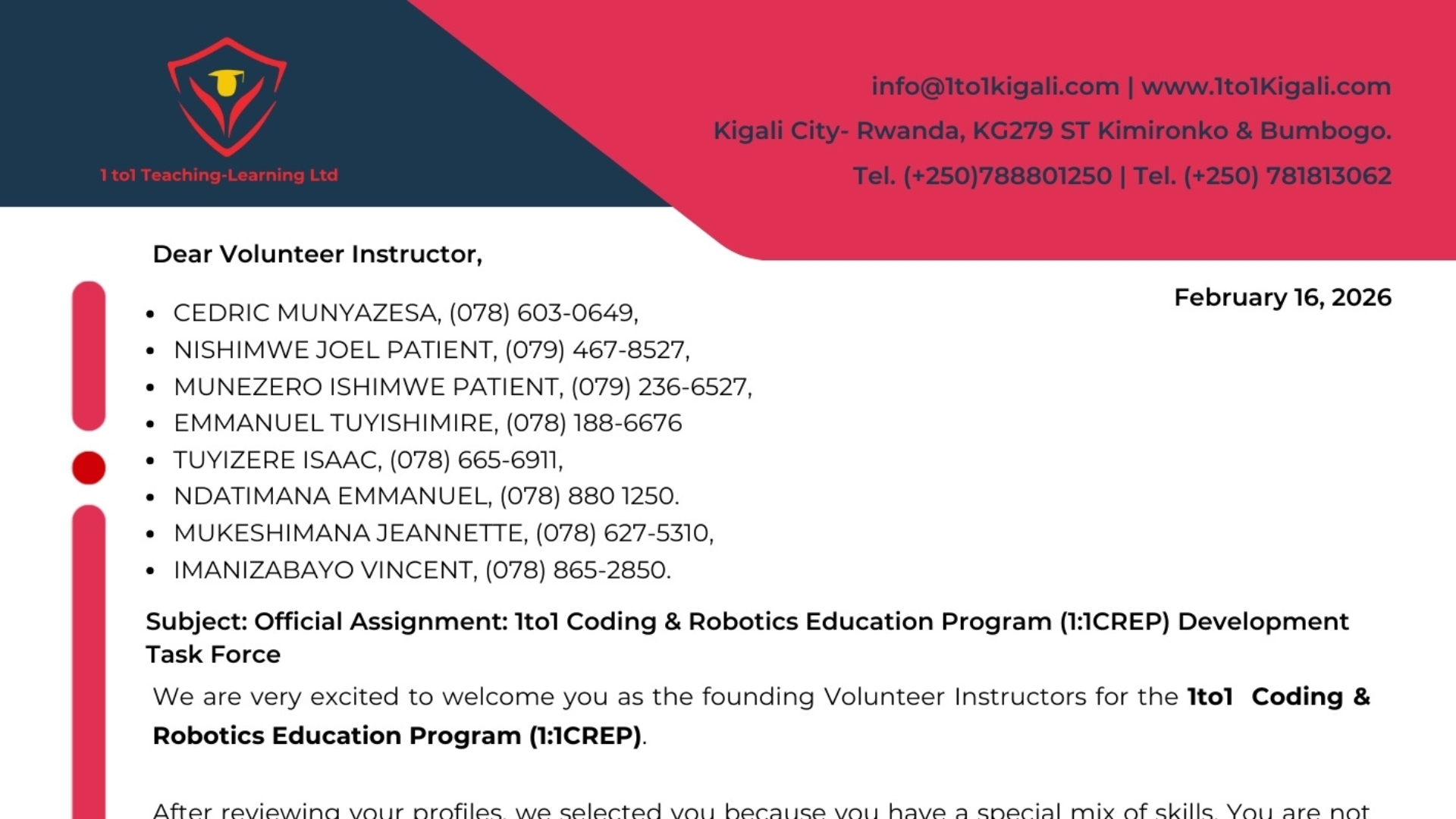
As formally outlined in the official assignment letter dated February 16, 2026, the organization has established a structured Development Task Force to design a complete curriculum spanning Nursery to University.
The Research Foundation is built on studies in early childhood cognitive development and industry-aligned curriculum design.
Empirical evidence supports early integration of computational thinking:
-
A meta-analysis on ICT integration in early childhood and primary education found statistically significant improvements in conceptual learning and problem-solving ability (Zuo et al., 2025).
-
Research in K–12 programming education shows that structured coding instruction improves computational thinking, academic motivation, and persistence in STEM pathways (Choi & Choi, 2024).
-
The World Bank (2023) highlights that less than 25% of tertiary students in Sub-Saharan Africa enroll in STEM disciplines, despite labor markets demanding digital and engineering competencies.
These findings underscore the importance of longitudinal curriculum models rather than isolated short-term programs.
The 1:1CREP model responds directly to this evidence through a progressive developmental structure:
-
Nursery – Algorithmic thinking through sequencing, pattern games, and logic play
-
Primary – Block-based programming and foundational robotics
-
Secondary – Python, C++, data analysis, electronics integration
-
University – Advanced robotics systems, automation, AI foundations, real-world engineering applications
Governance Structure: The Development Task Force
According to the official letter, the following roles have been formally assigned:
Panel Leaders
-
Cedric MUNYAZESA
-
MUNEZERO ISHIMWE Patient
Responsible for technical direction, robotics architecture, hardware integration, and engineering progression across levels.
Curriculum Architects
- TUYIZERE ISAAC
- MUKESHIMANA JEANNETTE
- IMANIZABAYO Vincent
- Emmanuel TUYISHIMIRE
Responsible for cognitive sequencing, syllabus design, interdisciplinary integration, and structural coherence from Nursery to University.
Quality Assurance Professionals
-
NDATIMANA EMMANUEL
-
NISHIMWE Joel Patient
Responsible for academic standards, instructional clarity, measurable learning outcomes, and ensuring alignment with international best practices.
Industry Consultants: Ensuring Industrial Relevance
To strengthen practical alignment with real-world technological ecosystems, the program integrates external consultants with active software engineering and robotics experience:
Ramadhani Shafii Wanjenja
A Software Engineer with practical experience in coding and robotics, Ramadhani provides a cross-border East African perspective. His involvement ensures that the curriculum aligns not only with local standards but also with evolving regional tech ecosystems, including Tanzania and the broader East African Community.
DEI Francois Audace
A practicing Software Engineer, Francois contributes hands-on industry insight into modern programming languages, robotics frameworks, and engineering workflows. His role ensures that theoretical instruction translates into applied competence.
The inclusion of consultants with active industry experience is strategically significant. Research consistently indicates that STEM programs disconnected from industry needs risk producing graduates lacking practical readiness (World Bank, 2023). By embedding engineers into curriculum design, 1:1CREP minimizes this risk.
A Structural Response to a Regional Skills Gap
Africa’s digital transformation strategies require more than infrastructure investments. UNESCO (2024) notes that limited digital skills acquisition remains a major barrier to economic competitiveness.
The 1:1CREP initiative directly addresses this gap by:
-
Establishing early exposure to computational logic
-
Integrating robotics as applied engineering practice
-
Creating cumulative mastery across 15+ years of structured education
-
Aligning pedagogy with both cognitive science and labor market needs
This is not an extracurricular club. It is a systemic curriculum intervention.
Strategic Implications for Rwanda and East Africa
Rwanda’s Vision 2050 and regional digital economy strategies emphasize innovation-led growth. However, innovation pipelines require:
-
Early talent identification
-
Progressive technical mastery
-
Industry mentorship
-
Quality-controlled curriculum
The 1:1CREP Development Task Force structure — combining educators, engineers, curriculum architects, and quality assurance — reflects an understanding that sustainable innovation ecosystems begin in the classroom.
The launch of the 1:1 Coding & Robotics Education Program marks a shift from fragmented STEM exposure toward a cohesive, research-informed, industry-aligned educational pipeline.
By integrating:
-
Early childhood cognitive development research
-
Structured curriculum architecture
-
Formal quality assurance
-
Regional software engineering consultants
1TO1 TEACHING LEARNING LTD positions itself not merely as a training provider, but as a systems-level educational innovator.
The blueprint has been established.
The leadership structure is formalized.
The research foundation is clear.
Now the implementation begins.