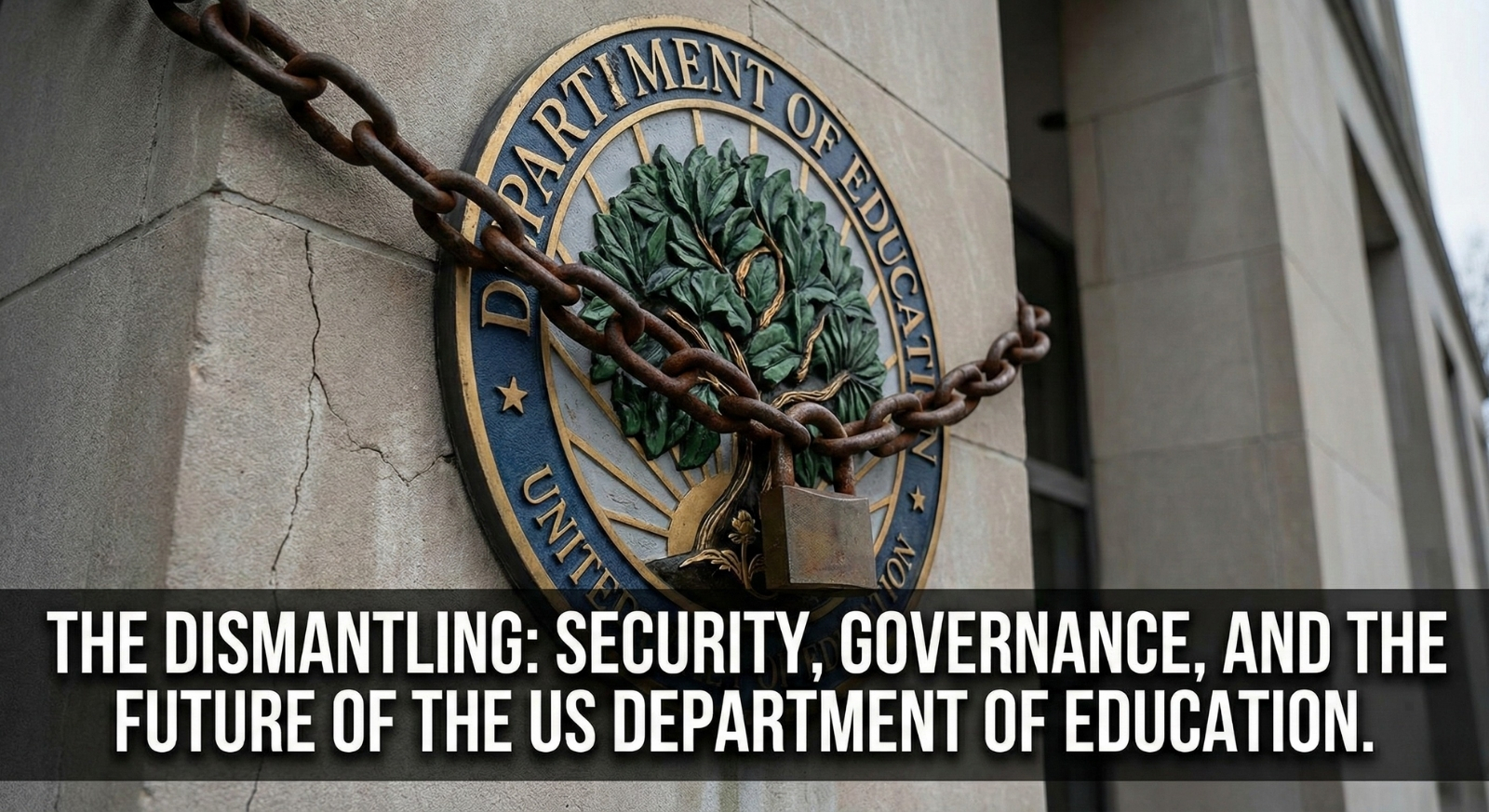
In Washington D.C., a quiet but seismic restructuring is underway. The United States Department of Education (ED), a cabinet-level fixture since 1980, is facing an existential transformation. Driven by a renewed focus on national security and a political mandate to reduce federal bureaucracy, the events of December 2025 suggest that the Department is being effectively dismantled from the inside out, with its key functions parceled out to other agencies.
The Great Migration of Programs
Reports from December 2025 confirm that the administration is executing a strategy of “administrative transfer” rather than legislative repeal. While Congress has not voted to abolish the Department, the executive branch is using interagency agreements to strip it of its portfolio.
Foreign Policy Alignment: The most symbolic move is the transfer of Title VI international and foreign language programs to the Department of State. The administration argues that these programs, which fund area studies centers and language training, are tools of “national security and foreign policy” rather than domestic education. This aligns educational exchange directly with geopolitical strategy.
Workforce Shift: Career and Technical Education (CTE) programs, including the massive Perkins grants, are moving to the Department of Labor. This reclassifies vocational education as “workforce development,” treating students primarily as economic units to be trained for industry.
Social Services: Programs like CCAMPIS (child care for student parents) are shifting to the Department of Health and Human Services (HHS), consolidating social support under one roof.
Critics argue this fragmentation will lead to a lack of coherent educational vision. Supporters, however, claim it streamlines oversight and places programs where they naturally belong. Despite these shifts, core mandates like IDEA (Special Education) and Title I (funding for poor schools) remain at the Department for now, protected by statute.
Section 117 and the Security Hawk Era
This restructuring is occurring against a backdrop of intense paranoia regarding foreign influence in academia. In December 2025, the Department launched a modernized portal for Section 117 reporting. This law requires universities to disclose foreign gifts and contracts valued at over $250,000.
The administration has weaponized this compliance tool, launching investigations into major research universities like Harvard, UPenn, University of Michigan, and UC Berkeley. The explicit goal is to “end the secrecy surrounding foreign funds” and prevent “foreign exploitation” of American research. This creates a chilling effect on international collaboration. Universities are now caught in a pincer movement: they need international funding to offset domestic cuts, but accepting it invites federal investigation.
The Gold Card and the Wealth Test
While the Department of Education shrinks, the Department of Homeland Security is expanding its role in shaping the student body. The launch of the “Gold Card” program on December 10, 2025, exemplifies the new philosophy. By charging a $15,000 “processing fee” for expedited vetting, the US is explicitly prioritizing wealthy immigrants and researchers.
Conclusion
The governance updates of December 2025 paint a picture of an American education system that is becoming less “educational” and more “geopolitical.” By moving programs to the State Department and the Department of Labor, the government is signalling that education is valuable primarily as a tool for national security and economic production. The Department of Education may still exist on paper, but its soul is being partitioned, creating a new landscape where university presidents must answer more often to diplomats and generals than to educators.