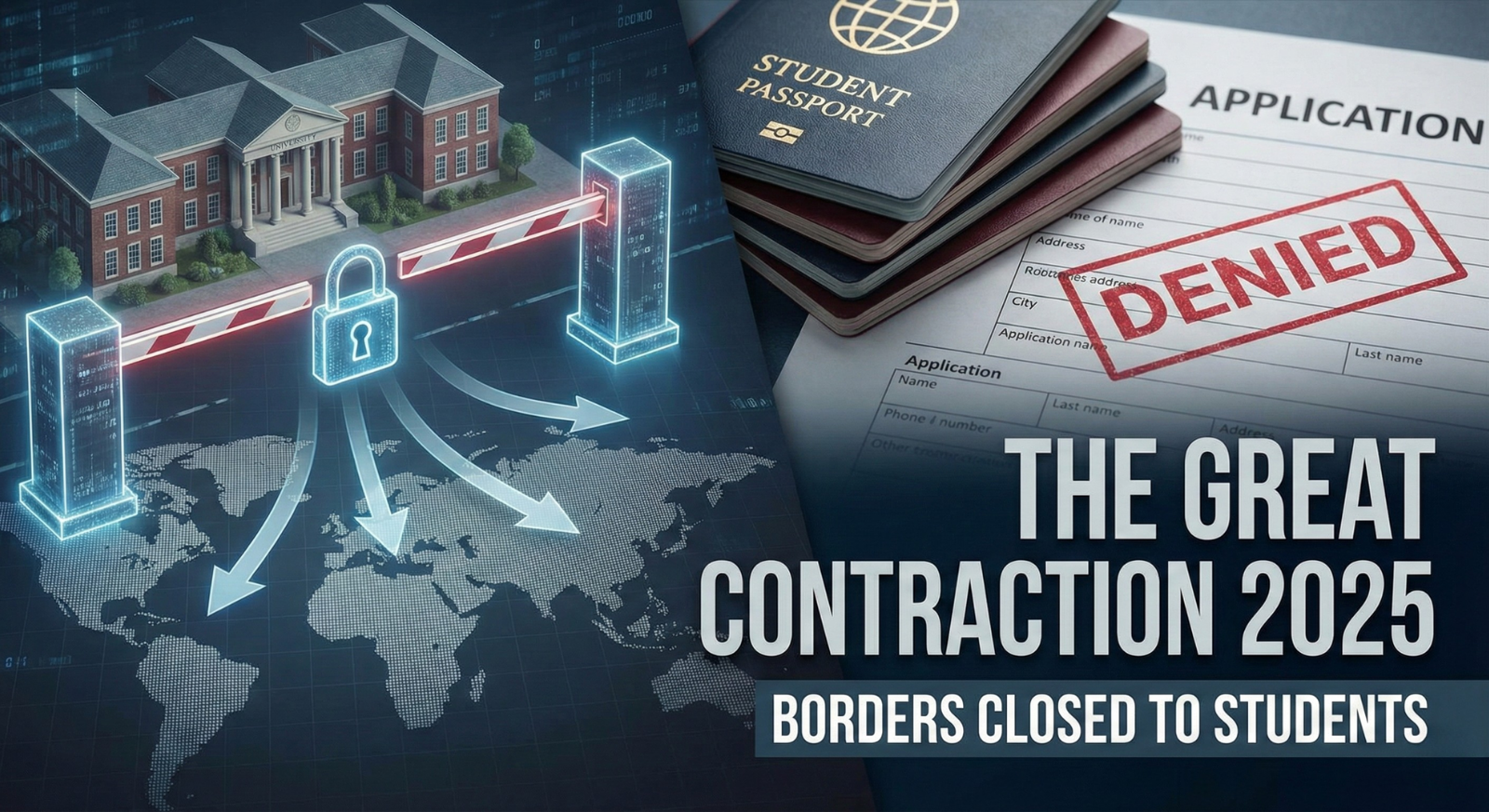
For two decades, the global international education market was defined by a single trajectory: up. Year after year, record numbers of students crossed borders, fueling a multi-billion dollar industry that subsidized universities and buoyed local economies. But in December 2025, that trajectory has not just flattened; it has reversed. A coordinated wave of restrictive policies across the “Big Four” English-speaking destinations—Canada, Australia, the United Kingdom, and the United States—has initiated what analysts are calling “The Great Contraction.” Driven by housing crises, political pressure to reduce net migration, and concerns over national security, these nations have erected higher walls than ever before.
Canada: The Hard Cap Reality
Canada, once the world’s most welcoming destination, has executed the most dramatic pivot. Following the imposition of an initial cap in 2024, the federal government announced in late 2025 that the target for new study permits for 2026 will be slashed to just 155,000. This represents a staggering reduction from the issuance levels of previous years (which exceeded 400,000) and marks a permanent shift to a managed-migration model.
The mechanism for this cut is the Provincial Attestation Letter (PAL) system, which allocates quotas to provinces. Ontario, the epicenter of the international student boom, has seen its allocation cut by 42%. This has forced the province to reduce undergraduate international study permits for universities by 33%, dropping from roughly 36,725 to 24,600. The financial shockwaves are immediate; Ontario universities are projecting a $265 million deficit for 2025-26, warning that the cuts threaten their ability to maintain world-class research and student services.
Crucially, Canada has exempted master’s and doctoral students from the PAL requirement starting January 1, 2026. This reveals the government’s strategy: curate a smaller, “higher-quality” cohort of advanced researchers while shutting the door on the masses of undergraduate and diploma students who have been blamed for straining housing markets.
Australia: The “Traffic Light” System and the Ghost College Crackdown
Australia’s approach is equally restrictive but operationally distinct. The government’s Mid-Year Economic and Fiscal Outlook (MYEFO) for December 2025 slashed the net overseas migration forecast to 310,000, with a further drop to 260,000 predicted for the following year. This reduction is being engineered through “integrity” measures designed to weed out non-genuine students.
The centerpiece of this crackdown is Ministerial Direction 115, effective November 14, 2025. This directive introduces a brutal “traffic light” processing system based on an institution’s “New Overseas Student Commencement” (NOSC) allocation.
Priority 1 (Green): Institutions that have not yet reached 80% of their cap. These visas are processed in 1-4 weeks.
Priority 2 (Amber): Institutions between 80% and 100% of their cap.
Priority 3 (Red): Institutions that have exceeded their cap by 15%. These applications face indefinite delays.
Furthermore, starting January 1, 2026, onshore visa applicants must provide a Confirmation of Enrolment (CoE) at the time of application—Letters of Offer are no longer accepted. This closes a loophole used by students to extend their stay by perpetually applying for new courses. The financial barrier has also risen, with visa fees doubling to AUD 2,000.
United Kingdom: Pricing Out the Market
The UK has opted for fiscal barriers over hard caps. Effective December 16, 2025, the Immigration Skills Charge (ISC) increased by 32%. For medium and large sponsors, the annual fee rose from £1,000 to £1,320 per worker. While technically an employer tax, this charge hits the university sector hard, as they are major sponsors of international academic talent.
More damaging for students is the looming reduction in post-study work rights. The government has confirmed that for those applying after January 1, 2027, the Graduate visa route will be cut from two years to 18 months. Additionally, English language requirements for Skilled Worker visas will jump to level B2 in January 2026. These changes erode the UK’s competitive advantage, signaling to students that while their tuition fees are welcome, their long-term presence is not.
United States: The Security Fortress
The United States remains a paradox: hungry for elite talent but increasingly paranoid about security. December 2025 saw the launch of the “Gold Card” program, an expedited processing lane for high-net-worth individuals willing to pay a $15,000 fee. This effectively creates a tiered system where wealth buys access.
Conversely, the White House expanded travel bans in December 2025, adding countries like Burkina Faso, Mali, and Sudan to the restricted list. Simultaneously, the Department of Education has ramped up Section 117 enforcement, launching a new portal to track foreign gifts to universities and opening investigations into elite institutions like Harvard and UC Berkeley. The message is clear: the US wants international minds, but only if they come with a “Gold Card” price tag and pass extreme security vetting.
Conclusion
The “Great Contraction” of 2025 is not a temporary dip; it is a structural realignment. The global north has collectively decided that the social and political costs of unfettered student mobility now outweigh the economic benefits. For students in the Global South, the dream of international education is becoming smaller, more expensive, and harder to reach.